Roulette is a game in which bets are settled on the pocket where the ball lands. A bet can cover one number or a group, such as red or odd numbers. The payout depends on the bet and the table rules; no outcome is guaranteed.
How does a round work?
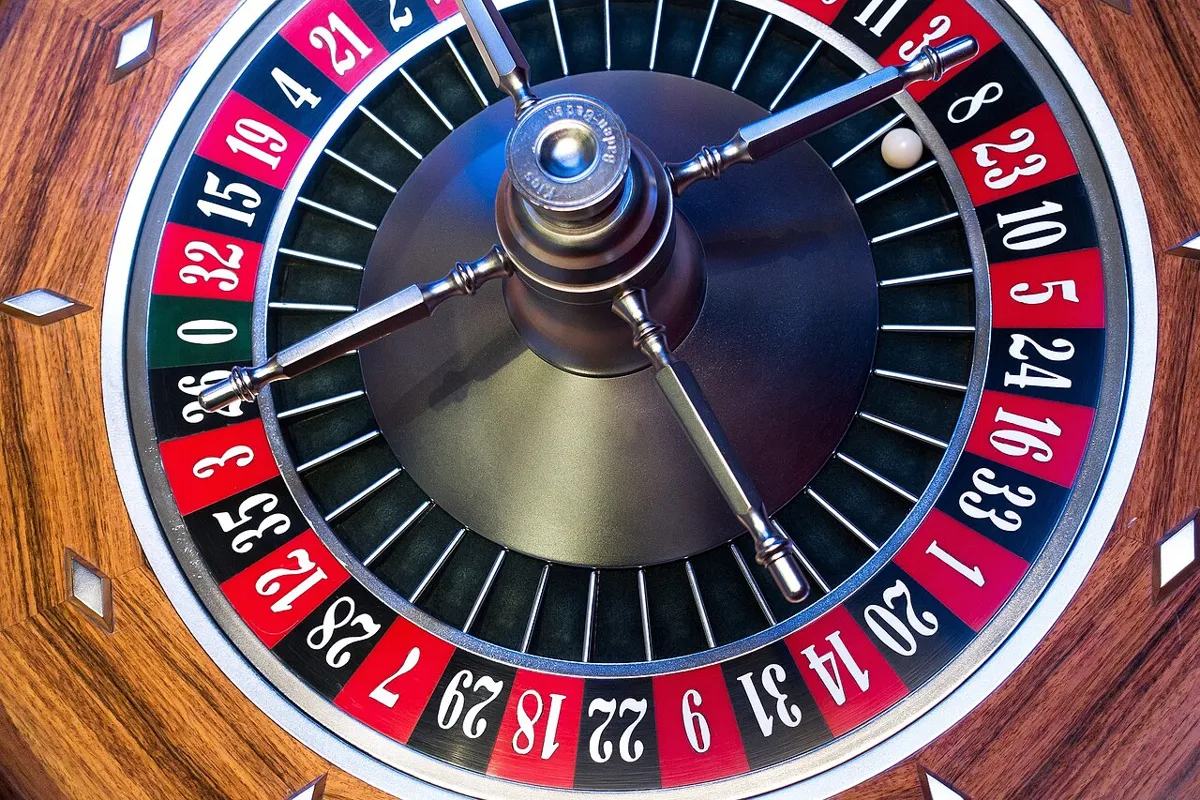
A roulette wheel has numbered pockets, sometimes called compartments, and a separate betting layout. Players place chips on a number or a marked group. Bets close before the result is settled; in an online game, the interface records the selection. A winning bet covers the result, while other bets are settled according to the table rules. A bet on 7, for example, does not win merely because a different red number appears.
European, American and French roulette
A conventional European wheel has 37 pockets: 1–36 and a single 0. The conventional American double-zero format has 38: 1–36, 0 and 00. The 00 is a separate pocket, not another name for 0 or the number 100. Not every table in the United States has a double-zero wheel; other formats, including triple-zero wheels, also exist. Check the actual wheel and payout table rather than relying on a name.
French roulette commonly uses a single-zero wheel. Some tables offer la partage, returning half of a losing even-money bet when 0 appears, or en prison, holding the bet for a later spin under the stated conditions. Neither rule follows automatically from the word “French”; check which bets and outcomes the particular rule covers.
The sum of the labels 0 through 36 is 666: 36 × 37 / 2. This is a property of that stated set of numbers, not a probability or a mystical signal. A differently labelled wheel needs its own calculation.
Inside and outside bets and payouts
Inside bets cover individual numbers or small groups on the numbered layout. Outside bets cover larger groups, including colors, parity, halves, dozens and columns. The following are common payouts, not a promise that every table uses them; special games may change payouts or add mechanics.
| Bet | Numbers covered | Winning profit |
|---|---|---|
| Straight up: one number | 1 | 35:1 |
| Split: two adjacent numbers on the layout | 2 | 17:1 |
| Street: three numbers in a row | 3 | 11:1 |
| Dozen or column | 12 | 2:1 |
| Red or black | 18 | 1:1 |
A payout of 35:1 means profit of 35 times the stake, in addition to the returned stake. In a hypothetical $1 straight-up bet, a win pays $35 profit and returns the $1 stake: $36 gross return, or $35 net profit for that bet. A loss costs the $1 stake. Gross return is not the same as net profit, and neither is total wagering turnover.
What do Odd, Even and the other fields mean?
- Odd / Even: odd numbers 1–35 or even numbers 2–36, respectively.
- Red / Black: the corresponding colored numbers.
- 1–18 / 19–36: the lower or upper half of the numbered range.
- 1st 12 / 2nd 12 / 3rd 12: the three dozens, 1–12, 13–24 and 25–36. A column also covers 12 numbers.
A dozen is consecutive on the layout, not necessarily on the wheel. Zero pockets are separate outcomes: they are not red or black and do not count as Odd, Even, a half, a dozen or a column, even though zero is mathematically even. Red, black, Odd, Even and the halves are often called even-money bets because a win commonly pays 1:1 profit. Depending on the table, a zero can cause a full loss or trigger a special settlement such as a half return; check the terms.
How do you calculate a chance?
For a specified event only when all outcomes in the model are equally likely, probability = favorable outcomes / all outcomes. In a teaching model of an ideal single-zero wheel with 37 equally likely pockets, one specified number, including 0, has probability 1/37, approximately 2.70%. Zero is not rarer than another individual number in that model. This assumption does not verify a real wheel.
Red covers 18 pockets in that model, so an ordinary calculator gives 18 ÷ 37 × 100 ≈ 48.65%. Zero is less likely than the whole red group, but not than one specified red number. An external roulette calculator is not needed for this calculation; no particular external service has been checked here. Different wheel layouts, bets or settlement rules require their own model.
For example, in a hypothetical single-zero model with equally likely pockets, a red bet paying 1:1 and losing the entire stake on black or zero has 18 winning and 19 losing outcomes. Its expected loss is 1/37 of the stake, about 2.70% over a large number of such bets. That is an average in this complete model, not a prediction of any session; a half-return rule or different payouts change the calculation. Betting systems and changing stake sizes do not make an independent next result due.
Software and live roulette: what can be checked?
Software roulette generally uses a random number generator to determine results; an animated wheel alone does not prove how a result was generated. Live roulette generally streams a physical wheel and ball, although equipment and extra game features vary. A video feed alone does not establish that a game is fair either.
A few spins, a streak or a long absence of one number cannot reliably prove fairness or cheating. On an independent random wheel, past results do not make a number “due” next. Check the game’s provider, rules and any licensing or testing claims against an independent source or the relevant official register; a regulator’s logo alone is not proof. The UK Gambling Commission’s RTS 7 sets requirements for applicable remote gambling systems, not a universal certification of every game online.
What should you check in the table rules?
Look for the number of zero pockets, the payout table, minimum and maximum bets, zero settlement and any extra mechanics. A general explanation cannot replace the rules of the specific game. No table or betting pattern guarantees a profit.
Sources and limits
- Gaming Clubs (Bankers’ Games) Regulations 1994, regulation 4: a historical British rule specifying a 37-pocket wheel and payout odds, with a half-loss provision on zero for specified bets. It is not a statement of current universal rules or US law.
- UK Gambling Commission: RTS 7: requirements for generation of random outcomes in its applicable remote-gambling framework.
- Wizard of Odds: Roulette: a secondary explanation of common layouts and payouts; individual games can differ.